Now Reading: Charges Dismissed Against Radiologist Who Drove Family Off Cliff: Mental Health Diversion Program Concludes in Controversial Case
-
01
Charges Dismissed Against Radiologist Who Drove Family Off Cliff: Mental Health Diversion Program Concludes in Controversial Case
Charges Dismissed Against Radiologist Who Drove Family Off Cliff: Mental Health Diversion Program Concludes in Controversial Case

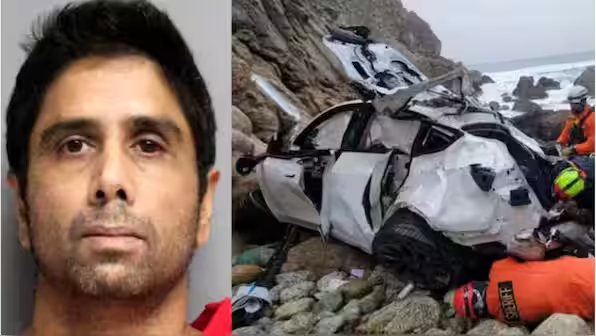
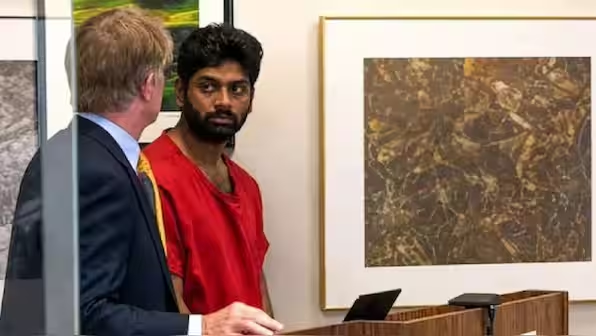
A San Mateo County judge has dismissed all attempted murder charges against Dr. Dharmesh Patel, 45, a radiologist from Pasadena, California, following his completion of a two-year mental health diversion program. The dismissal marks the conclusion of one of California’s most troubling yet complicated cases, involving the January 2, 2023 incident where Patel drove his Tesla off a 250-foot cliff along the Pacific Coast Highway known as Devil’s Slide, injuring his wife and two young children.
The crash was called an “absolute miracle” as all four family members miraculously survived, though they sustained significant injuries. The case sparked intense debate about criminal accountability, mental illness, and California’s mental health diversion laws enacted in 2023, which allow individuals accused of crimes to receive treatment instead of prosecution when they qualify under specific criteria.
Patel told a psychiatrist after his arrest that he was depressed and had delusions that his children, ages 4 and 7 at the time, would be trafficked by kidnappers. Medical experts testified that Patel was experiencing episodic major depression with hallucinations when he drove his family off the cliff, a psychiatric condition that qualified him for mental health diversion under California law.
A San Mateo County judge dismissed the charges on Monday after Patel completed a two-year mental health diversion program with a Stanford psychiatrist and a family therapist. The program required rigorous commitment, including regular sessions with both a psychiatrist and a social worker, living at his parents’ home in Belmont under GPS monitoring, and undergoing twice-weekly testing to confirm he was taking prescribed medication.
The case has proven extraordinarily controversial among law enforcement and prosecutors. San Mateo District Attorney Steve Wagstaffe and other California district attorneys have argued that attempted murder should be excluded from eligibility for mental health diversion, and they’re working with lawmakers to amend the law.
Yet the victim’s perspective has transformed the narrative entirely. Patel’s wife testified that she had forgiven her husband and did not want him to be prosecuted, saying her children missed their father and they wanted him back home. She described the incident as “a mental health episode beyond any of our understanding or control” and characterized Patel as a “kind and altruistic” man whose family desperately needed him.
The Medical Board of California barred Patel from practicing medicine while he faced attempted murder charges, and Patel surrendered his California medical license in December, effectively ending his medical career despite the criminal charges being dismissed.
After the charges were dismissed, Patel walked to the courtroom gallery where his wife was waiting and the two left the building together, marking reconciliation and family reunification following three years of separation and legal uncertainty.
The case illuminates the profound tension between accountability for violent actions and compassion for individuals experiencing severe mental health crises, raising difficult questions about justice, treatment, forgiveness, and societal responsibility toward those suffering from psychiatric illnesses.